The France Chicago Collection
For the past 6 years FCC has collaborated with the University of Chicago Press to help bring seminal works of French literature and thought to an English-speaking public. Based on this success, FCC and the University of Chicago Press announced in 2021 the creation of a new “France Chicago Collection” a series of at least five books to be published over the next 5 years. We are thrilled to present the first four books in the collection, featured below.

The Legacy of Enlightenment
Ambivalences of Modernity
Antoine Lilti. Translated by C. Jon Delogu
Going against the grain, this refreshing book argues for a non-ideological portrait of the Enlightenment as having been, above all else, a self-critical enterprise.
The Enlightenment has come under substantial attack over the past several years, with some going so far as to recommend leaving behind its thinkers and their Eurocentric prejudices. In response, the most orthodox defenders of the Enlightenment have insisted that its values are not just foundational but indispensable and that abandoning them would mean opening the door to nihilism and relativism. For Antoine Lilti, one of the leading scholars of the French Enlightenment, both sides are wrong.
In this tactfully argued series of essays, Lilti emphasizes a non-dogmatic, non-ideological view of the Enlightenment—one that sees its legacy as a critical, attentive approach that can and should serve as its own best critic. Along the way, he engages with everyone from Rousseau and Kant to Foucault and Habermas, as well as prominent contemporary voices, such as Jonathan Israel. The result is a remarkable new reading of the Enlightenment that redraws the stakes of old debates and offers an alternative way to engage with both canonical thinkers and later scholarship that is both honest about the past and useful for the future.
The France Chicago Collection. Published January 2026.

Waiting for Robots
The Hired Hands of Automation
Antonio A.Casilli. With a Foreword by Sarah T.Roberts. Translated by Saskia Brown.
An essential investigation that pulls back the curtain on automation, like AI, to show human workers’ hidden labor.
Artificial Intelligence fuels both enthusiasm and panic. Technologists are inclined to give their creations leeway, pretend they’re animated beings, and consider them efficient. As users, we may complain when these technologies don’t obey, or worry about their influence on our choices and our livelihoods. And yet, we also yearn for their convenience, see ourselves reflected in them, and treat them as something entirely new. But when we overestimate the automation of these tools, award-winning author Antonio A. Casilli argues, we fail to recognize how our fellow humans are essential to their efficiency. The danger is not that robots will take our jobs, but that humans will have to do theirs.
In this bracing and powerful book, Casilli uses up-to-the-minute research to show how today’s technologies, including AI, continue to exploit human labor—even ours. He connects the diverse activities of today’s tech laborers: platform workers, like Uber drivers and Airbnb hosts; “micro workers,” including those performing atomized tasks like data entry on Amazon Mechanical Turk; and the rest of us, as we evaluate text or images to show we’re not robots, react to Facebook posts, or approve or improve the output of generative AI. As Casilli shows us, algorithms, search engines, and voice assistants wouldn’t function without unpaid or underpaid human contributions. Further, he warns that if we fail to recognize this human work, we risk a dark future for all human labor.
Waiting for Robots urges us to move beyond the simplistic notion that machines are intelligent and autonomous. As the proverbial Godot, robots are the bearers of a messianic promise that is always postponed. Instead of bringing prosperity for all, they discipline the workforce, so we don’t dream of a world without drudgery and exploitation. Casilli’s eye-opening book makes clear that most “automation” requires human labor—and likely always will—shedding new light on today’s consequences and tomorrow’s threats of failing to recognize and compensate the “click workers” of today.
The France Chicago Collection. Published January 2025.

Wittgenstein
The Senses of Use
Sandra Laugier. Translated by Daniela Ginsburg.
A holistic introduction to Wittgenstein’s philosophy that approaches him as a philosopher of ordinary life.
One of philosopher Ludwig Wittgenstein’s most consequential claims was that the meaning of the word, its sense, is its use in language. This deceptively simple claim, the foundation of what became known as ordinary language philosophy, has animated thinkers across disciplinary bounds from metaphysics to ethics and more. In The Senses of Use, Sandra Laugier embarks on a fresh journey through Wittgenstein’s corpus that emphasizes the place of ordinary life and language in its thought. Through his Tractatus Logico-Philosophicus, Philosophical Investigations, and rich posthumously published works, Laugier offers a compelling new look at Wittgenstein as a philosopher of mind.
The France Chicago Collection. Published October 2025.

Einstein and the Quantum Revolutions
Alain Aspect. With a Foreword by David Kaiser. Translated by Teresa Lavender Fagan.
A Nobel laureate offers a brief lesson on physics’ biggest mystery, accessibly explaining the two quantum revolutions that changed our understanding of reality.
At the start of the twentieth century, the first quantum revolution upset our vision of the world. New physics offered surprising realities, such as wave-particle duality, and led to major inventions: the transistor, the laser, and today’s computers. Less known is the second quantum revolution, arguably initiated in 1935 during a debate between giants Albert Einstein and Niels Bohr. This revolution is still unfolding. Its revolutionaries—including the author of this short accessible book, Nobel Prize–winning physicist Alain Aspect—explore the notion of entangled particles, able to interact at seemingly impossible distances. Aspect’s research has helped to show how entanglement may both upend existing technologies, like cryptography, and usher in entirely new ones, like quantum computing. Explaining this physics of the future, this work tells a story of how philosophical debates can shape new realities.
The France Chicago Collection. Published October 2024.
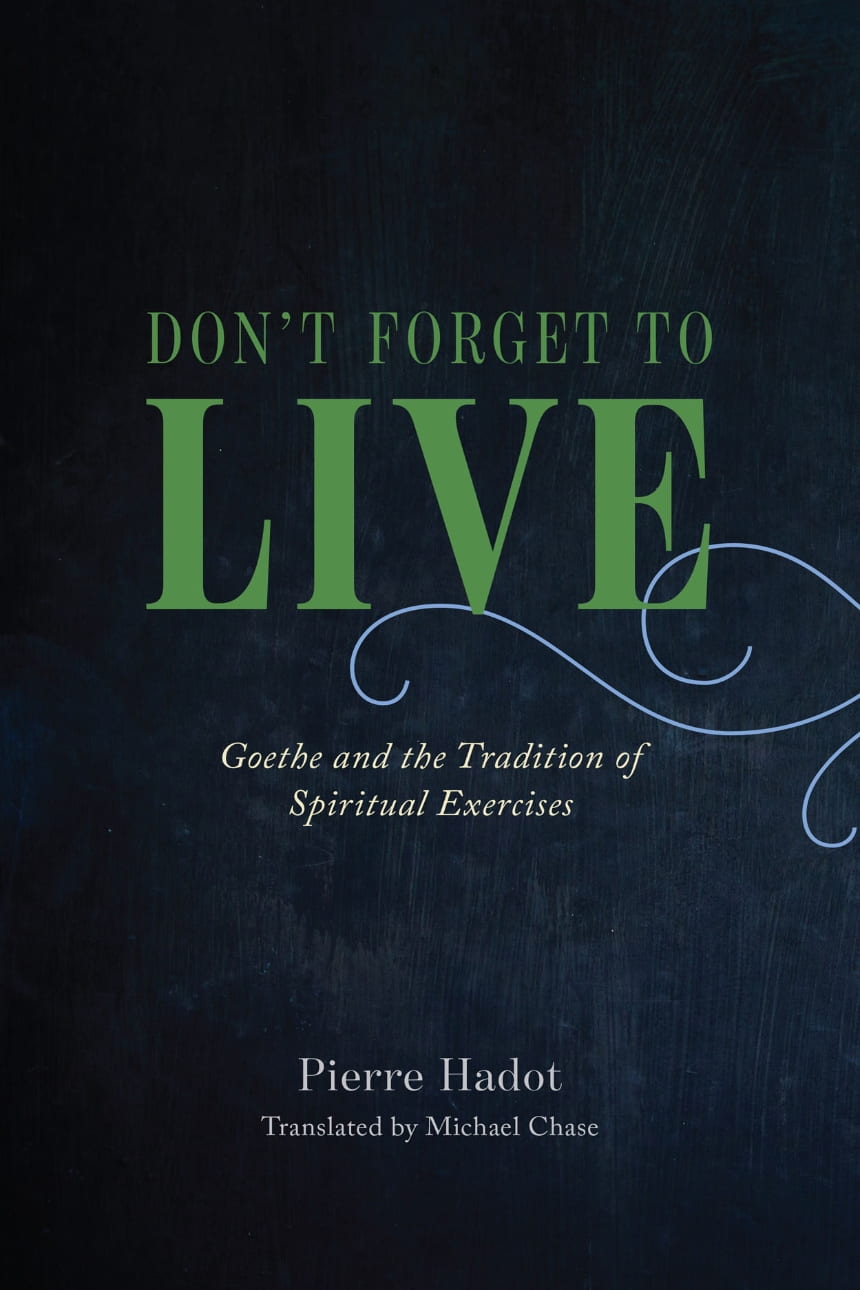
Don’t Forget to Live: Goethe and the Tradition of Spiritual Exercises
Pierre Hadot. Translated by Michael Chase. With a Foreword by Arnold I. Davidson and Daniele Lorenzini.
The esteemed French philosopher Pierre Hadot’s final work, now available in English.
In his final book, renowned philosopher Pierre Hadot explores Goethe’s relationship with ancient spiritual exercises—transformative acts of intellect, imagination, or will. Goethe sought both an intense experience of the present moment as well as a kind of cosmic consciousness, both of which are rooted in ancient philosophical practices. These practices shaped Goethe’s audacious contrast to the traditional maxim memento mori (Don’t forget that you will die) with the aim of transforming our ordinary consciousness. Ultimately, Hadot reveals how Goethe cultivated a deep love for life that brings to the forefront a new maxim: Don’t forget to live.
The France Chicago Collection. Published April 2023.
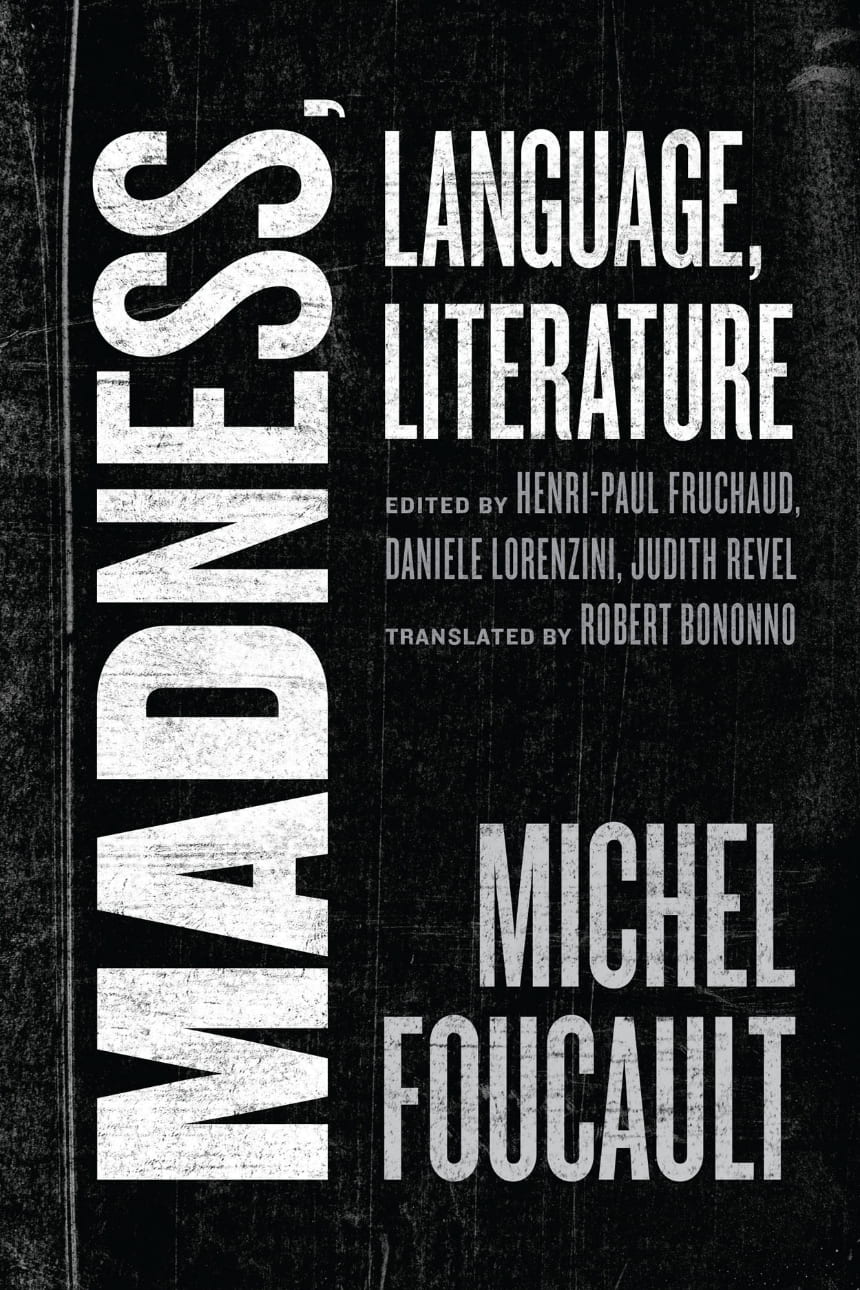
Madness, Language, Literature
Michel Foucault. Edited by Henri-Paul Fruchaud, Daniele Lorenzini, and Judith Revel. Translated by Robert Bononno.
Newly published lectures by Foucault on madness, literature, and structuralism.
Perceiving an enigmatic relationship between madness, language, and literature, French philosopher Michel Foucault developed ideas during the 1960s that are less explicit in his later, more well-known writings. Collected here, these previously unpublished texts reveal a Foucault who undertakes an analysis of language and experience detached from their historical constraints. Three issues predominate: the experience of madness across societies; madness and language in Artaud, Roussel, and Baroque theater; and structuralist literary criticism. Not only do these texts pursue concepts unique to this period such as the “extra-linguistic,” but they also reveal a far more complex relationship between structuralism and Foucault than has typically been acknowledged.
The France Chicago Collection & The Chicago Foucault Project. Published April 2023.

Travels in the Americas: Notes and Impressions of a New World
Albert Camus. Edited by Alice Kaplan. Translated by Ryan Bloom.
Albert Camus’s lively journals from his eventful visits to the United States and South America in the 1940s, available again in a new translation.
In March 1946, the young Albert Camus crossed from Le Havre to New York. Though he was virtually unknown to American audiences at the time, all that was about to change—The Stranger, his first book translated into English, would soon make him a literary star. By 1949, when he set out on a tour of South America, Camus was an international celebrity. Camus’s journals offer an intimate glimpse into his daily life during these eventful years and showcase his thinking at its most personal—a form of observational writing that the French call choses vues (things seen).
Camus’s journals from these travels record his impressions, frustrations, joys, and longings. Here are his unguarded first impressions of his surroundings and his encounters with publishers, critics, and members of the New York intelligentsia. Long unavailable in English, the journals have now been expertly retranslated by Ryan Bloom, with a new introduction by Alice Kaplan. Bloom’s translation captures the informal, sketch-like quality of Camus’s observations—by turns ironic, bitter, cutting, and melancholy—and the quick notes he must have taken after exhausting days of travel and lecturing. Bloom and Kaplan’s notes and annotations allow readers to walk beside the existentialist thinker as he experiences changes in his own life and the world around him, all in his inimitable style.
The France Chicago Collection. Published March 2023.
Thinking Out of Sight: Writings on the Art of the Visible
Jacques Derrida. Edited by Ginette Michaud, Joana Masó, and Javier Bassas. With New Translations by Laurent Milesi.
Jacques Derrida remains a leading voice of philosophy, his works still resonating today—and for more than three decades, one of the main sites of Derridean deconstruction has been the arts. Collecting nineteen texts spanning from 1979 to 2004, Thinking out of Sight brings to light Derrida’s most inventive ideas about the making of visual artworks. With many texts appearing for the first time in English, Thinking out of Sight helps us better understand the critique of representation and visibility throughout Derrida’s work, and, most importantly, to assess the significance of his insights about art and its commentary.
The inaugural selection of The France Chicago Collection. Published April 2021.
Previous Collaborations with UChicago Press